Journal Metrics & Indexing
Indexing
Authors grant IJVES the right to include their articles in indexation services, even if these services operate on a commercial basis. IJVES is indexed by
Baidu Scholar: (Baidu Xueshu, 百度学术) is a Chinese academic search engine developed by Baidu, similar to Google Scholar. It helps users find research papers, theses, conference proceedings, patents, and other academic resources.
BASE: Bielefeld Academic Search Engine (BASE) is one of the world's most voluminous search engines especially for academic web resources. BASE provides more than 300 million documents from more than 10,000 content providers. You can access the full texts of about 60% of the indexed documents for free (Open Access).
Crossref: Crossref manages and maintains a database of metadata information that describes and identifies professional and scholarly materials and content and persistent identifiers such as Digital Object Identifiers (DOI) that point to or give context to the content online.
DOAJ: The Directory of Open Access Journals (DOAJ) is a unique and extensive index of diverse open access journals from around the world, driven by a growing community, committed to ensuring quality content is freely available online for everyone.
EBSCO Discovery Service: EBSCO offers high-quality articles licensed from reputable publishers recognized by library professionals, chosen to meet the specific needs of researchers.
Google Scholar: Google Scholar is a search engine of the Google LLC company and is used for general literature research of scientific documents.
SSOAR: The full-text server SSOAR, which is maintained at GESIS – Leibniz Institute for the Social Sciences, collects and archives literature of relevance to the social sciences and makes it available in open access on the Internet in accordance with the Berlin Declaration on Open Access to Knowledge in the Sciences and Humanities.
Norwegian Register for Scientific Journals, Series and Publishers: The Norwegian Register for Scientific Journals, Series and Publishers gives you an overview over approved academic publication channels and information about them.
VET Repository: The VET Repository of the Federal Institute for Vocational Education and Training (BIBB) is the disciplinary repository for literature on all aspects of vocational education and training (VET) and VET research.
Most read articles
The following articles are the most read articles since 2024. We count file views, i.e. downloads of the PDF [May 2026].
1127 views: Peter-Jörg Alexander: The Transition from the Education to the Employment System in Japan — A Balancing Act between Continuity and Change. [vol. /no.1, 2024]
932 views: Chris Zirkle, Eli Smeplass & Arve Leraand: VET Teacher Training: A Comparison of University Programs in the U.S. and Norway. [vol. 1/no. 2, 2024]
917 views: Niklas Sänger: Evaluation of Digital Competencies Development of an Instrument for Vocational Teacher Training. [vol. 1/no.2, 2024]
841 views: Malaka Samara: TVET History and Reform. The Case of Palestine. [vol. 1/no. 1, 2024]
723 views: Beifang Ma & Esther Winther: Longitudinal Analysis of School-Workplace Cooperation in Vocational Training. Exploring Time-Invariant and Time-Varying Predictors [vol. 2/ no. 1, 2025]
Most read article per issue:
The following articles are the most read articles per issue. We count file views, i.e. downloads of the PDF [May 2026].
2025, Volume 2
No. 1: Beifang Ma & Esther Winther: Longitudinal Analysis of School-Workplace Cooperation in Vocational Training. Exploring Time-Invariant and Time-Varying Predictors (723 views)
No. 2: Erica Smith: From ITABs to Jobs and Skills Councils: A contribution to the history of Sector Skills Councils in Australia (334 views)
2024, Volume 1
No. 1: Peter-Jörg Alexander: The Transition from the Education to the Employment System in Japan — A Balancing Act between Continuity and Change (1127 views)
No. 2: Chris Zirkle, Eli Smeplass & Arve Leraand: VET Teacher Training: A Comparison of University Programs in the U.S. and Norway (932 views)
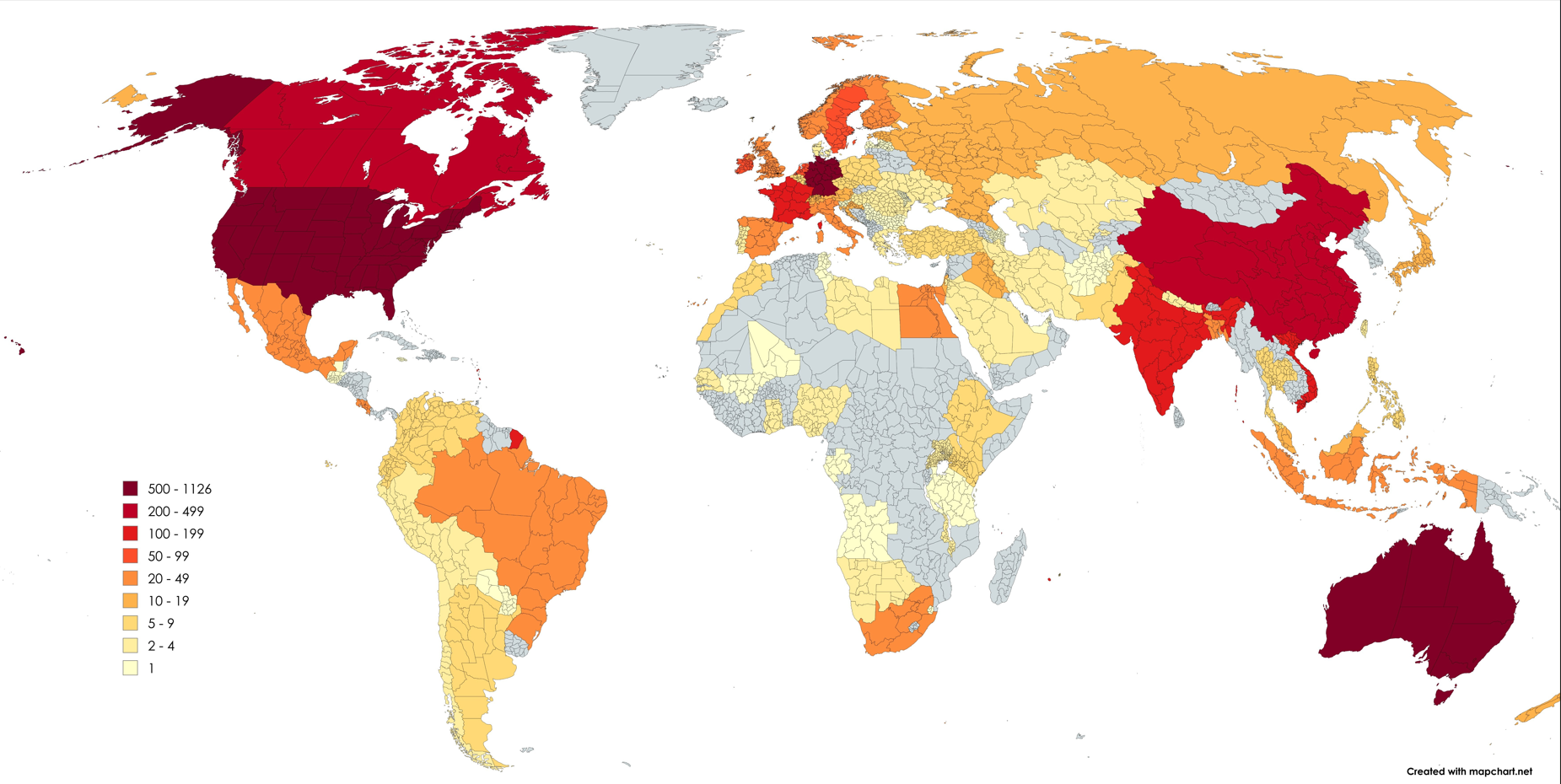
Readership
The articles we publish reach a global readership. The map below shows the number of views and downloads for each country between 2024 and today [May 2026]: