Supporting Peer Feedback Formulation in a Video-Based Digital Platform in Technical Vocational Education
Article Sidebar
Main Article Content
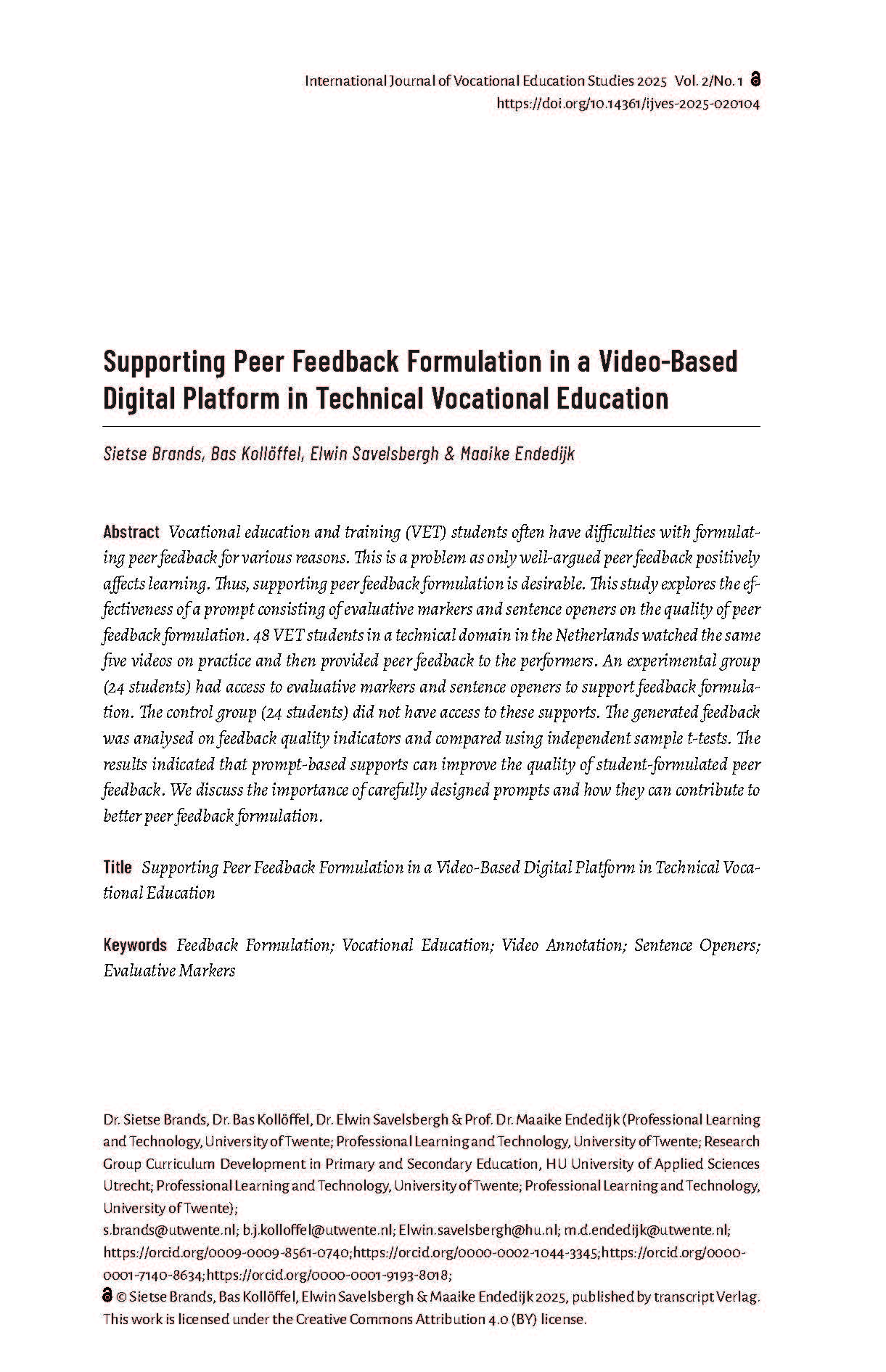
Abstract
Vocational education and training (VET) students often have difficulties with formulating peer feedback for various reasons. This is a problem as only well-argued peer feedback positively
affects learning. Thus, supporting peer feedback formulation is desirable. This study explores the effectiveness of a prompt consisting of evaluative markers and sentence openers on the quality of peer
feedback formulation. 48 VET students in a technical domain in the Netherlands watched the same five videos on practice and then provided peer feedback to the performers. An experimental group
(24 students) had access to evaluative markers and sentence openers to support feedback formulation. The control group (24 students) did not have access to these supports. The generated feedback
was analysed on feedback quality indicators and compared using independent sample t-tests. The results indicated that prompt-based supports can improve the quality of student-formulated peer
feedback. We discuss the importance of carefully designed prompts and how they can contribute to better peer feedback formulation.
Article Details
Issue
Section
References
Aamri, K. S. A. (2018). Teacher-Researchers’ Reflective Narratives on Their Experiences at the Language Center Research Committee, Sultan Qaboos University, Oman. 10, 15.
Alqassab, M., Strijbos, J.-W., Panadero, E., Ruiz, J. F., Warrens, M., & To, J. (2023). A Sys-tematic Review of Peer Assessment Design Elements. Educational Psychology Review, 35(1), 18. https://doi.org/10.1007/s10648-023-09723-7
Andrade, H. L. (2019). A Critical Review of Research on Student Self-Assessment. Frontiers in Education, 4. https://www.frontiersin.org/articles/10.3389/feduc.2019.00087
Barkhuizen, G., & Wette, R. (2008). Narrative frames for investigating the experiences of language teachers. System, 36(3), 372–387. https://doi.org/10.1016/j.system.2008.02.002
Boldrini, E., & Cattaneo, A. (2014). Scaffolding Collaborative Reflective Writing in a VET Curriculum. Vocations and Learning, 7(2), 145–165. https://doi.org/10.1007/s12186-014-9110-3
Cattaneo, & Motta, E. (2020). “I Reflect, Therefore I Am… a Good Professional”. On the Re-lationship between Reflection-on-Action, Reflection-in-Action and Professional Perfor-mance in Vocational Education. Vocations and Learning. https://doi.org/10.1007/s12186-020-09259-9
Colasante, M., & Douglas, K. (2016). Prepare-Participate-Connect: Active Learning with Video Annotation. Australasian Journal of Educational Technology, 32(4), 68–91.
Evi-Colombo, A., Cattaneo, A., & Bétrancourt, M. (2020). Technical and Pedagogical Af-fordances of Video Annotation: A Literature Review. Journal of Educational Multimedia and Hypermedia, 29(3), 193–226.
Farkas, K. (2019). Reflective templates in language teacher education: A pilot study on Hun-garian and Turkish pre-service EFL teachers’ beliefs. 12.
Gavota, M. C., Cattaneo, A., Arn, C., Boldrini, E., Motta, E., Schneider, D., & Betrancourt, M. (2010). Computer‐supported peer commenting: A promising instructional method to promote skill development in vocational education. Journal of Vocational Education & Training, 62(4), 495–511. https://doi.org/10.1080/13636820.2010.529499
Gielen, S., Peeters, E., Dochy, F., Onghena, P., & Struyven, K. (2010). Improving the effec-tiveness of peer feedback for learning. Learning and Instruction, 20(4), 304–315. https://doi.org/10.1016/j.learninstruc.2009.08.007
Harris, L. R., & Brown, G. T. L. (2013). Opportunities and obstacles to consider when using peer- and self-assessment to improve student learning: Case studies into teachers’ imple-mentation. Teaching and Teacher Education, 36, 101–111. https://doi.org/10.1016/j.tate.2013.07.008
Hattie, J., & Timperley, H. (2007). The Power of Feedback. Review of Educational Research, 77(1), 81–112. https://doi.org/10.3102/003465430298487
Hulsman, R. L., & van der Vloodt, J. (2015). Self-evaluation and peer-feedback of medical students’ communication skills using a web-based video annotation system. Exploring content and specificity. Patient Education and Counseling, 98(3), 356–363. https://doi.org/10.1016/j.pec.2014.11.007
Jossberger, H., Brand‐Gruwel, S., Boshuizen, H., & van de Wiel, M. (2010). The challenge of self‐directed and self‐regulated learning in vocational education: A theoretical analysis and synthesis of requirements. Journal of Vocational Education & Training, 62(4), 415–440. https://doi.org/10.1080/13636820.2010.523479
Jossberger, H., Brand-Gruwel, S., van de Wiel, M. W. J., & Boshuizen, H. P. A. (2015). Teachers’ Perceptions of Teaching in Workplace Simulations in Vocational Education. Vocations and Learning, 8(3), 287–318. https://doi.org/10.1007/s12186-015-9137-0
Kollar, I., & Fischer, F. (2010). Peer assessment as collaborative learning: A cognitive per-spective. Learning and Instruction, 20(4), 344–348. https://doi.org/10.1016/j.learninstruc.2009.08.005
Kori, K., Pedaste, M., Leijen, Ä., & Mäeots, M. (2014). Supporting reflection in technology-enhanced learning. Educational Research Review, 11, 45–55. https://doi.org/10.1016/j.edurev.2013.11.003
Lai, C.-Y., Chen, L.-J., Yen, Y.-C., & Lin, K.-Y. (2020). Impact of video annotation on un-dergraduate nursing students’ communication performance and commenting behaviour during an online peer-assessment activity. Australasian Journal of Educational Technolo-gy, 36(2), Article 2. https://doi.org/10.14742/ajet.4341
Lavoué, É., Molinari, G., Prié, Y., & Khezami, S. (2015). Reflection-in-action markers for re-flection-on-action in Computer-Supported Collaborative Learning settings. Computers & Education, 88, 129–142. https://doi.org/10.1016/j.compedu.2015.05.001
Leung, K. C., & Shek, M. P. (2021). Adoption of video annotation tool in enhancing stu-dents’ reflective ability level and communication competence. Coaching: An International Journal of Theory, Research and Practice, 0(0), 1–11. https://doi.org/10.1080/17521882.2021.1879187
McFadden, J., Ellis, J., Anwar, T., & Roehrig, G. (2014). Beginning Science Teachers’ Use of a Digital Video Annotation Tool to Promote Reflective Practices. Journal of Science Edu-cation and Technology, 23. https://doi.org/10.1007/s10956-013-9476-2
Mikkonen, S., Pylväs, L., Rintala, H., Nokelainen, P., & Postareff, L. (2017). Guiding work-place learning in vocational education and training: A literature review. Empirical Re-search in Vocational Education and Training, 9(1). https://doi.org/10.1186/s40461-017-0053-4
OECD. (2013). OECD Skills Outlook 2013: First Results from the Survey of Adult Skills. OECD. https://doi.org/10.1787/9789264204256-en
Ortoleva, G., & Bétrancourt, M. (2016). Supporting productive collaboration in a computer-supported instructional activity: Peer-feedback on critical incidents in health care educa-tion. Journal of Vocational Education & Training, 68(2), 178–197. https://doi.org/10.1080/13636820.2015.1133693
Panadero, E. (2017). A Review of Self-regulated Learning: Six Models and Four Directions for Research. Frontiers in Psychology, 8. https://doi.org/10.3389/fpsyg.2017.00422
Panadero, E., & Alqassab, M. (2019). An empirical review of anonymity effects in peer as-sessment, peer feedback, peer review, peer evaluation and peer grading. Assessment & Evaluation in Higher Education, 44(8), 1253–1278. https://doi.org/10.1080/02602938.2019.1600186
Panadero, E., & Jonsson, A. (2013). The use of scoring rubrics for formative assessment purposes revisited: A review. Educational Research Review, 9, 129–144. https://doi.org/10.1016/j.edurev.2013.01.002
Panadero, E., & Jonsson, A. (2020). A critical review of the arguments against the use of ru-brics. Educational Research Review, 30. https://doi.org/10.1016/j.edurev.2020.100329
Panadero, E., & Lipnevich, A. A. (2022). A review of feedback models and typologies: To-wards an integrative model of feedback elements. Educational Research Review, 35, 100416. https://doi.org/10.1016/j.edurev.2021.100416
Prilop, C. N., Weber, K. E., Prins, F. J., & Kleinknecht, M. (2021). Connecting feedback to self-efficacy: Receiving and providing peer feedback in teacher education. Studies in Edu-cational Evaluation, 70. https://doi.org/10.1016/j.stueduc.2021.101062
Roth, W.-M. (2014). Rules of bending, bending the rules: The geometry of electrical conduit bending in college and workplace. Educational Studies in Mathematics, 86(2), 177–192.
Schaap, H., Baartman, L., & de Bruijn, E. (2012). Students’ Learning Processes during School-Based Learning and Workplace Learning in Vocational Education: A Review. Vo-cations and Learning, 5(2), 99–117. https://doi.org/10.1007/s12186-011-9069-2
Schaap, H., Khaled, A., Faber, M., Bijlsma, N., & Bruijn, E. de. (2023). Vocational knowledge development during teacher-student interactions: Exploring vocational con-versations. Pedagogische Studiën, 100(1), Article 1. https://doi.org/10.59302/ps.v100i1.13990
Shute, V. J. (2008). Focus on Formative Feedback. Review of Educational Research, 78(1), 153–189. https://doi.org/10.3102/0034654307313795
Strijbos, J.-W., Narciss, S., & Dünnebier, K. (2010). Peer feedback content and sender’s competence level in academic writing revision tasks: Are they critical for feedback percep-tions and efficiency? Learning and Instruction, 20(4), 291–303. https://doi.org/10.1016/j.learninstruc.2009.08.008
van Joolingen, W. R., de Jong, T., Lazonder, A. W., Savelsbergh, E. R., & Manlove, S. (2005). Co-Lab: Research and development of an online learning environment for collab-orative scientific discovery learning. Computers in Human Behavior, 21(4), 671–688. https://doi.org/10.1016/j.chb.2004.10.039
Yiong‐Hwee, T., & Churchill, D. (2007). Using Sentence Openers to Support Students’ Ar-gumentation in an Online Learning Environment. Educational Media International, 44(3), 207–218. https://doi.org/10.1080/09523980701491658